
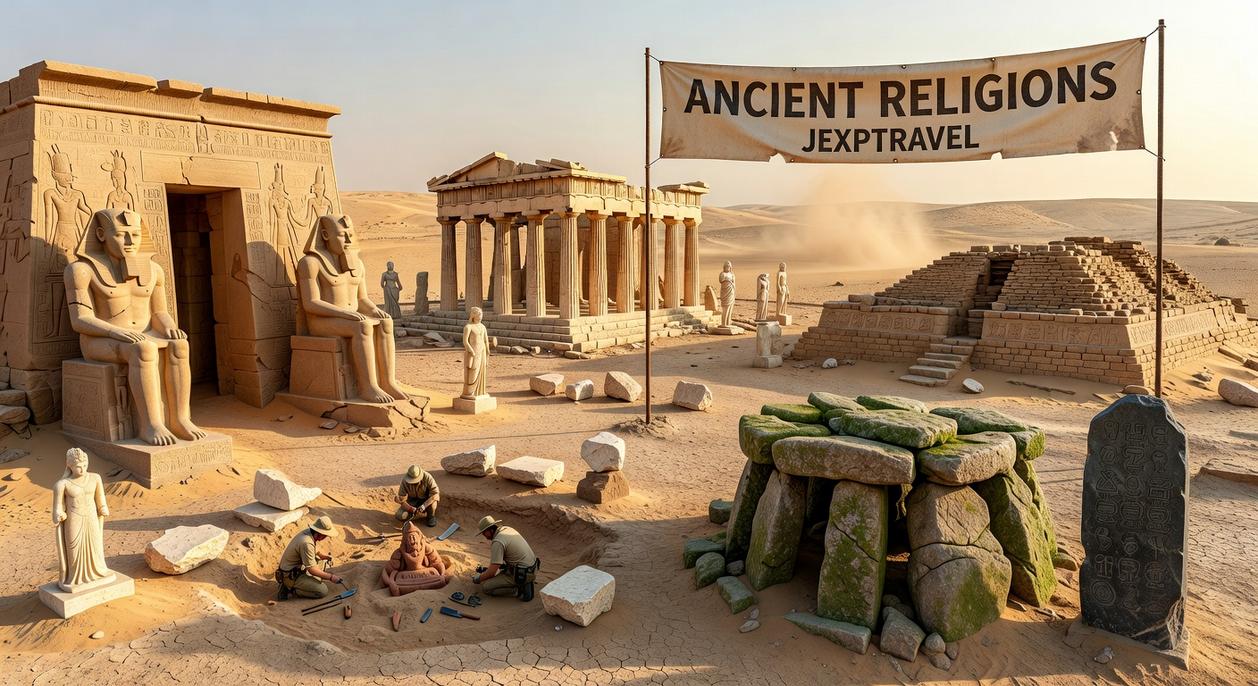
I’ve visited dozens of ancient sites around the world and watched thousands of tourists walk through them like they’re checking boxes off a list.
You take photos. You follow the tour guide. You leave.
But here’s what you’re missing: the beliefs that built these places. The spiritual systems that shaped entire civilizations. The context that turns a pile of stones into something that matters.
Most people visit Angkor Wat or Machu Picchu and come home with great pictures but zero understanding of the religions that created them.
I’m going to show you how to change that.
This guide walks you through combining travel with real research. You’ll learn how to prepare before you go, what to look for when you’re there, and how to explore these sites with respect and depth.
What are ancient religions jexptravel? It’s about moving beyond surface-level tourism. It’s about understanding the spiritual foundations that drove people to build temples, carve monuments, and create sacred spaces that still stand today.
I’ve spent years figuring out how to make these trips meaningful instead of just memorable. The methods I use turn a standard vacation into something closer to a pilgrimage.
You’ll walk away knowing how to connect with the past in a way that actually sticks with you.
No fluff. Just practical steps for travelers who want more than a selfie.
The Foundation: Pre-Trip Research for a Deeper Connection
Most people book a trip to ancient sites and figure they’ll just read the plaques when they get there.
I did that once. Stood in front of the Parthenon with zero context about Athena’s role in Athenian daily life. It was beautiful, sure. But I felt like I was looking at a really old building instead of a sacred space that shaped an entire civilization.
Here’s what I wish someone had told me.
The research you do before you go? That’s what turns a photo op into something that sticks with you.
Choosing Your Focus
You can’t study every ancient religion before your trip. You’ll burn out before you even pack.
Pick one region or pantheon that pulls at you. Maybe it’s Greco-Roman gods because you grew up reading Percy Jackson (no shame, those books slap). Or Norse mythology because you want to understand the context behind those Viking sites in Scandinavia. Or Mesoamerican cosmology because the pyramid structures fascinate you.
I’m being honest here. I don’t know why certain mythologies resonate with different people. Some folks feel drawn to Egyptian death rituals while others want to understand Shinto shrine practices. There’s no wrong answer.
What matters is that you actually care enough to dig in.
Beyond Wikipedia
Wikipedia is fine for a starting point. But if you want real depth, you need better sources.
I go straight to primary texts in translation. The Iliad for Greek religion. The Prose Edda for Norse beliefs. The Popol Vuh for Maya cosmology. These aren’t always easy reads (some are genuinely confusing), but they show you how people actually talked about their gods.
Academic journals help too. JSTOR and Google Scholar give you access to research that breaks down what scholars think certain rituals meant. And I say think because honestly? We’re still debating a lot of this stuff.
Museum archives are goldmine resources. The British Museum and the Met both have online collections with context about artifacts you might see in person.
For what are ancient religions jexptravel covers, this research phase matters more than your actual itinerary.
Mapping the Mythology
I keep a simple document for each trip.
One section lists key deities with their roles, symbols, and the drama between them. Think of it like a character sheet for a game. Zeus: sky god, lightning bolts, terrible with boundaries. Hera: marriage goddess, deeply vindictive when crossed.
Another section tracks major religious shifts. When did this religion peak? When did it decline? What replaced it?
Then I map sacred geographies. Which rivers were holy? Which mountains housed gods? Which cities served as religious centers?
This sounds like homework because it kind of is. But when you’re standing at Delphi and you know why that specific mountain mattered to Apollo worship, the place hits different.
Understanding the Why
Here’s where most travel guides fail you.
They’ll tell you the myths. They won’t tell you how religion shaped daily life.
I want to know what regular people did every morning. Did they pray at home shrines? Offer food to household gods? Avoid certain actions on holy days?
I want to understand how religion connected to power. Did priests influence politics? Did emperors claim divine ancestry? Were temples also banks?
The social structures matter too. Who could participate in certain rituals? Who was excluded?
I’ll admit something. Sometimes the sources contradict each other. Sometimes we just don’t know because the records didn’t survive. That’s frustrating when you want clear answers, but it’s also part of what makes this interesting.
You’re not just learning facts. You’re piecing together how people made sense of their world.
From Text to Territory: Where to Walk in the Footsteps of the Ancients
Most travel guides tell you where the temples are.
They don’t tell you why they’re there.
The Nile’s Pantheon: Ancient Egypt
The Book of the Dead wasn’t a book. It was a map for the soul’s journey through the underworld.
When you walk through the Valley of the Kings, you’re not just looking at tombs. You’re standing inside that map. Every corridor descends deeper into the Duat (the Egyptian underworld). Every painted wall shows you the tests the dead faced.
Then there’s Karnak and Luxor. People see ruins. I see what are ancient religions jexptravel really about: cosmic engines built to maintain order between heaven and earth. The priests didn’t just pray here. They performed daily rituals to keep the sun rising and the Nile flooding.
Walk the Sacred Lake at dawn. That’s when you feel it.
The Mesoamerican Cosmos: Maya & Aztec Lands
The Popul Vuh describes creation happening on a sacred mountain where the gods mixed corn and water to form humans.
Now look at Tikal. Every pyramid is that mountain. The Maya didn’t build random structures. They recreated the cosmos in stone.
At Chichen Itza, stand at the base of El Castillo during the spring equinox. Watch the shadow of a serpent descend the stairs. That’s Kukulkan returning to earth, exactly as the calendar predicted centuries ago.
The landscape itself was sacred. Rivers were portals to Xibalba (the underworld). Caves were wombs of creation.
You can’t understand these sites from a guidebook. You have to stand there when the light hits right.
The Roots of Dharma: Ancient India & Nepal
Buddha’s life wasn’t metaphor. It happened in real places you can visit today.
Start at Lumbini in Nepal where he was born under a sal tree. The exact spot is marked. Then travel to Bodh Gaya where he sat under the Bodhi tree and figured it all out.
End at Sarnath where he gave his first teaching to five monks in a deer park.
This isn’t like where to travel in France jexptravel covers popular sites. This is walking the actual path of awakening. Early Buddhist texts describe these locations in detail. The distances between them. The trees. The rivers.
When you make this pilgrimage, you’re not touring. You’re retracing 2,500 years of footsteps.
The Art of Mindful Exploration: Best Practices on the Ground

Most travelers show up at sacred sites around noon with a tour group of forty people.
They snap a few photos and leave.
I used to do the same thing. Then I realized I wasn’t actually seeing anything.
Here’s what changed for me.
Timing Makes All the Difference
Get to major sites early. I mean really early. Before the buses arrive and the gift shops open.
There’s something about a temple at dawn that you just can’t experience at midday. The light hits differently. You can actually hear your own thoughts.
Late afternoon works too. Most tour groups clear out by 4 PM (they’ve got dinner reservations). That’s when you get the place almost to yourself.
Some people argue that timing doesn’t matter. They say a site is a site regardless of when you visit. But I’ve been to Angkor Wat at noon and at sunrise. Trust me, it matters.
The Small Stuff Tells the Real Story
Walk past the main altar or central monument. Look at the corners. The side chapels. The worn steps where thousands of feet have passed.
I found some of my favorite details this way. A tiny carving of a merchant’s prayer. Faded paint that shows what the whole place looked like centuries ago. Marks left by everyday worshippers who came here long before it became a tourist site.
When exploring where can i see the nothern lights from jexptravel or studying what are ancient religions jexptravel, the same principle applies. The magic is in the details you almost miss.
Get a Guide Who Actually Knows Their Stuff
Not all guides are created equal. I’ve had guides who just recite Wikipedia entries. And I’ve had guides with archaeology degrees who completely changed how I understood a place.
Look for specialists. Ask your hotel or guesthouse for recommendations. Check if local universities offer guided tours. It costs more but the difference is night and day.
Remember Where You Are
These aren’t museums. They’re sacred spaces where people have worshipped for centuries. Some still do.
Dress appropriately. Cover your shoulders and knees when required. Keep your voice down. If locals are praying, give them space.
I’ve seen travelers treat temples like playgrounds. It’s uncomfortable to watch and disrespectful to the communities who maintain these places.
Beyond the Ruins: Integrating the Journey Post-Travel
You made it back home.
Your camera roll is packed with temple shots and your notebook is filled with scribbles about gods you can barely pronounce now.
But here’s what usually happens next. Those photos sit in your phone. Your notes gather dust. And within a few weeks, the whole trip starts to feel like a blur.
I don’t want that for you.
Organize by Story, Not by Date
Forget sorting your photos chronologically. That’s boring and it misses the point.
Instead, group everything by theme or deity. Put all your Athena-related content together. Your Egyptian afterlife notes in one place. Your photos of fertility goddesses in another folder.
When you organize this way, patterns emerge. You start seeing connections between what you researched and what you actually experienced standing in those spaces.
I do this with a simple folder system on my computer. One main folder called “what are ancient religions jexptravel” with subfolders for each belief system I explored.
Keep Learning After You Land
The trip doesn’t end at the airport.
Check out your local museum. Most cities have collections with artifacts from ancient cultures. Seeing a Greek vase or Roman sculpture up close after visiting those sites? It hits different.
You can also trace how these old beliefs shaped what came after. Christianity borrowed from mystery religions. Islam built on earlier monotheistic traditions. Buddhism evolved from Hindu concepts.
Pro tip: Join online forums or local groups focused on ancient history. Your fresh perspective from recent travel adds real value to those conversations.
Turn Your Experience Into Something Others Can Use
Write it down. Make a photo essay. Record a video walking through what you learned.
Focus on the narrative arc of your journey. How did understanding Mesopotamian creation myths change the way you saw the ziggurat? What surprised you about Roman household gods when you visited Pompeii?
This isn’t about showing off. It’s about helping the next person travel with more context and depth than you had.
Your Next Chapter in an Ancient Story
You’ve wandered through ruins before and felt like something was missing.
The stones were impressive. The views were beautiful. But you couldn’t quite connect with what these places once meant to the people who built them.
That disconnect ends here.
You now have a complete framework for exploring what are ancient religions jexptravel. You can turn a simple trip into a real investigation of human history and belief.
No more standing at temple gates wondering what happened inside. No more reading plaques that don’t answer your actual questions.
When you blend research with mindful travel, you unlock something deeper. These sites stop being photo ops and start telling their stories.
You forge a personal connection to places that have mattered for thousands of years.
Here’s what you do next: Pick a single myth. Or a single deity. Or a single ancient city that’s been calling to you.
Let that be your starting point.
Do your research before you go. Learn the stories. Understand the rituals. Know what you’re looking at when you arrive.
That one choice becomes the first step on your next great adventure.
 Blyxara Dwell